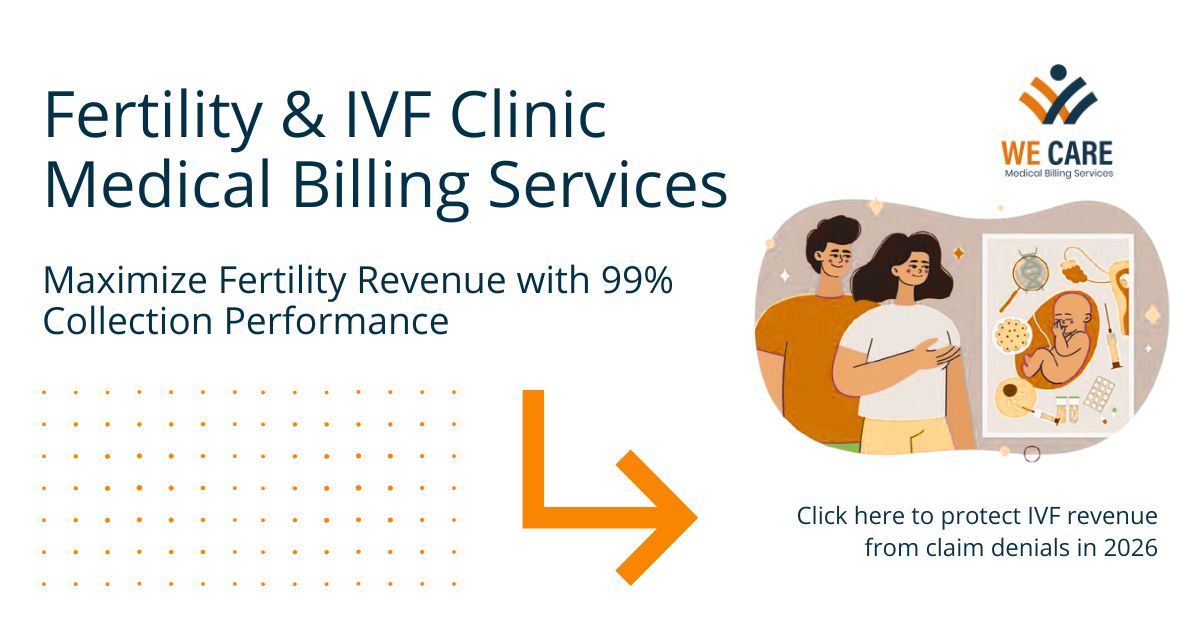
Fertility care is one of the fastest-growing specialties in healthcare. Rising infertility rates, increasing demand for assisted reproductive technology (ART) and expanded insurance coverage have pushed fertility clinics to treat more patients than ever. However, growth in patient volume also brings billing complexity, compliance risks, and rising claim denial rates.
Fertility billing services help reproductive clinics manage complex insurance rules, multi-stage treatment cycles, self-pay patients, and strict coding requirements. Without specialized billing support, fertility providers often experience delayed reimbursements, denied IVF claims, and significant revenue leakage. Industry reports show that fertility-related medical claims had an average denial rate of nearly 14% in 2023, while specialty-specific billing teams have reduced denial rates to below 7% in 2026 through improved coding accuracy and payer-specific claim strategies.
This guide explains how fertility billing services work, why they are essential in 2026, common billing challenges fertility clinics face, and how outsourcing fertility revenue cycle management improves financial performance.
Understanding Fertility Billing Services
Fertility billing services are specialized medical billing solutions designed specifically for reproductive endocrinology and infertility treatment providers. These services focus on managing the complex administrative and financial workflows involved in fertility care, including IVF procedures, embryology laboratory services, fertility preservation treatments, and hybrid insurance and self-pay billing models.
Unlike general medical billing, fertility billing involves multi-stage treatment cycles, laboratory coordination, employer fertility benefits, and extensive prior authorization requirements. Fertility billing teams ensure accurate documentation, proper coding, and payer compliance while helping clinics maintain consistent cash flow and minimize claim denials.
Why Fertility Billing Is More Complex Than General Medical Billing
The fertility healthcare landscape continues to expand due to rising infertility rates, increased employer fertility coverage, and broader acceptance of fertility preservation treatments. While these developments create new growth opportunities for fertility clinics, they also introduce additional revenue cycle challenges.
Industry data shows that average denial rates across general healthcare specialties ranged between 12% and 15% in 2023. By 2026, fertility and reproductive medicine denial rates have increased to approximately 18% to 25%. The increase is largely due to payer authorization requirements, treatment cycle documentation complexities, and evolving CMS regulatory standards.
More than 70% of fertility procedures now require prior authorization, and payer coverage policies frequently vary based on employer-sponsored benefits, state mandates, and medical necessity requirements. Fertility billing services help clinics navigate these complexities while maintaining compliance and financial stability.
CMS Updates Affecting Fertility Billing in 2026
Centers for Medicare and Medicaid Services (CMS) continue to increase oversight of reproductive healthcare billing, particularly for fertility preservation services and medically necessary infertility treatments.
CMS now places stronger emphasis on documenting medical necessity, especially when fertility preservation is performed for patients undergoing oncology treatments or gender-affirming medical care. Providers must maintain detailed clinical documentation linking diagnosis, treatment plans, and procedure outcomes to justify reimbursement eligibility.
CMS also continues expanding recognition of fertility preservation services for medically indicated conditions. Accurate coding and documentation are essential to avoid payment delays and audit exposure. Billing teams must verify that reproductive procedures clearly align with medical necessity criteria to ensure successful claim processing.
The Role of the No Surprises Act in Fertility Billing
Although fertility treatments are frequently elective, the No Surprises Act (NSA) still impacts certain fertility services in 2026. Out-of-network consultations, anesthesia services, laboratory services, and medically necessary fertility preservation procedures may fall under NSA cost transparency requirements.
Fertility clinics must provide Good Faith Estimates for uninsured or self-pay patients, clearly outlining anticipated treatment costs and financial responsibilities. Billing teams play a critical role in preparing accurate cost projections and maintaining documentation to meet federal transparency regulations. Failure to comply with NSA requirements may lead to regulatory penalties and patient billing disputes.
Core Functions of Fertility Billing Services
Insurance Eligibility Verification
Insurance coverage for fertility treatments varies significantly across payers and employer benefit plans. Fertility billing teams verify coverage details before treatment begins, including lifetime benefit limits, cycle restrictions, medication coverage, embryo storage eligibility, and donor service coverage. Eligibility verification reduces the risk of unexpected patient balances and prevents claims from being denied due to coverage limitations or policy exclusions.
Prior Authorization Management
Most fertility treatments require prior authorization before services are performed. Procedures commonly requiring authorization include IVF cycles, intrauterine insemination, embryo transfer procedures, cryopreservation services, and fertility preservation treatments. Fertility billing teams coordinate authorization submissions, track approval timelines, verify treatment cycle limitations, and ensure clinical documentation meets payer requirements. Authorization tracking prevents treatment delays and protects reimbursement eligibility.
Coding and Documentation Accuracy
Accurate coding is essential for fertility claim approval. Reproductive medicine involves specialized CPT and HCPCS codes related to surgical procedures, laboratory services, embryo handling, and tissue storage.
Common fertility billing codes include:
- CPT 58970 – Follicle puncture for oocyte retrieval
- CPT 58974 – Embryo transfer procedure
- CPT 89250 – Culture of oocytes or embryos
- CPT 89258 – Cryopreservation of embryos
- CPT 89342 – Storage of reproductive tissue
Incorrect coding often results in bundling errors, reduced reimbursement, or claim rejections. Fertility billing specialists review treatment documentation carefully to ensure coding accuracy and payer compliance.
Self-Pay and Financial Counseling Support
Fertility clinics frequently operate under hybrid payment models that combine insurance reimbursement with patient self-pay responsibility. Fertility billing services help clinics implement financial counseling programs, payment plan management, and patient financing coordination. Providing cost transparency and structured payment solutions improves treatment acceptance rates and strengthens patient trust while supporting consistent clinic cash flow.
Common Fertility Billing Challenges
Multi-Cycle Treatment Billing
Fertility treatments often involve multiple treatment stages that must be billed separately or bundled depending on payer policies. Errors frequently occur when services are billed before cycle completion or when treatment plans change mid-cycle. Billing teams must closely track each treatment phase to maintain accurate claim submission timelines.
Rapidly Changing Payer Policies
Insurance fertility coverage continues evolving as employers expand fertility benefit programs and states implement fertility coverage mandates. Billing teams must continuously monitor payer policy updates, coverage limitations, and authorization requirements to prevent billing errors and reimbursement delays.
Documentation Gaps
Incomplete clinical documentation is one of the leading causes of fertility claim denials. Missing infertility diagnosis details, treatment cycle records, embryology laboratory reports, and medication treatment protocols can result in rejected claims or payer audits. Fertility billing services implement documentation review processes to ensure all required clinical information is submitted with claims.
How Fertility Billing Services Improve Clinic Performance
Specialized fertility billing services help clinics reduce claim denials by applying payer-specific coding standards and authorization tracking workflows. Accurate claim submission improves reimbursement speed and reduces accounts receivable days.
Professional billing support also enhances patient experience by providing financial clarity, minimizing billing disputes, and helping patients understand treatment costs before procedures begin. Fertility billing teams also monitor payer contract compliance and reimbursement trends, helping clinics identify revenue leakage and optimize billing performance.
Geographic Variations in Fertility Billing Requirements
Fertility billing requirements vary based on state regulations, employer benefit structures, and payer policies. Clinics operating in California must comply with state fertility insurance mandates while managing high patient demand for IVF and fertility preservation treatments. Billing teams must coordinate state coverage mandates with employer-sponsored benefit plans to maintain reimbursement eligibility.
Texas fertility clinics frequently manage hybrid self-pay and insurance treatment models. Accurate financial counseling and eligibility verification are essential for maintaining consistent collections.
New York requires coverage for specific fertility treatments under state insurance mandates. Billing teams must ensure documentation supports coverage eligibility and aligns with state regulatory guidelines.
Florida fertility providers often encounter variable employer fertility coverage policies. Detailed eligibility verification processes help clinics avoid coverage disputes and patient billing complications.
Case Study:
A multi-location fertility practice experienced declining financial performance despite increasing patient demand. The clinic struggled with frequent claim denials, delayed authorization approvals, and inconsistent patient collections.
The billing audit identified several key challenges, including expired prior authorizations during treatment cycles, incorrect coding of embryology laboratory services, incomplete documentation linking infertility diagnoses to procedures, and limited patient financial counseling programs.
The revenue cycle team implemented structured authorization tracking systems, standardized coding review protocols, and documentation compliance checklists. Financial counseling services were expanded to improve patient payment coordination, and automated insurance verification workflows were introduced.
Within nine months, the clinic reduced denial rates from 24% to 8%, decreased accounts receivable days by 38%, and increased patient payment collections by 41%. Treatment cycle approval delays were significantly reduced, allowing providers to focus more on patient care rather than administrative challenges.
The Growing Role of Technology in Fertility Billing
Fertility billing continues transitioning toward automated eligibility verification systems and AI-supported denial prediction tools. These technologies allow billing teams to identify claim errors before submission and improve overall revenue cycle efficiency.
Advanced revenue cycle platforms also help clinics manage employer fertility benefit integrations, monitor payer reimbursement trends, and maintain compliance with evolving regulatory requirements. Clinics adopting technology-driven billing workflows often achieve faster reimbursements and improved financial forecasting.
Selecting the Right Fertility Billing Partner
Fertility clinics benefit most from billing providers who demonstrate deep expertise in reproductive medicine coding, authorization management, and regulatory compliance. A qualified fertility billing partner should provide complete revenue cycle management support, including insurance verification, IVF coding expertise, denial prevention strategies, and NSA compliance guidance.
Clinics should also evaluate billing partners based on their ability to integrate with existing EMR systems, maintain HIPAA-compliant data security protocols, and provide transparent performance reporting.
The Future of Fertility Billing
Fertility billing will continue evolving as reproductive technologies advance and payer coverage expands. Regulatory oversight is expected to increase, particularly regarding documentation requirements and cost transparency regulations. Employer-sponsored fertility benefit programs will continue growing, creating additional billing complexity for clinics.
Clinics that invest in specialized fertility billing services and advanced revenue cycle management strategies will be better positioned to maintain compliance, improve reimbursement performance, and support long-term operational growth.
Final Thoughts
Fertility billing services play a vital role in helping reproductive healthcare providers navigate the financial and regulatory complexities of modern fertility treatment. Accurate coding, detailed documentation, authorization management, and patient financial coordination are essential for maintaining stable revenue performance and delivering high-quality patient care. As fertility treatments continue expanding in 2026 and beyond, clinics must adopt specialized billing expertise to protect revenue, maintain compliance with CMS regulations, and support patient access to advanced reproductive healthcare services.
Contact We Care Medical Billing today to schedule a consultation and see how specialized fertility billing can transform your practice’s financial performance.